


In today’s digital landscape, organizations face relentless pressure to innovate and bring products to market with unprecedented speed and precision. Engineers and designers must balance competing demands—streamlining weight, maximizing performance, and keeping manufacturing costs in check. This year (2026), generative design AI has emerged as a transformative force, automating complex exploratory processes that once required months of manual iteration. By harnessing advanced algorithms alongside scalable computing resources, teams can now generate and evaluate thousands of design options in a fraction of the time.
What Is Generative Design AI?
Defining the Concept
Generative design AI is an iterative computational approach that produces a multitude of design alternatives based on user-defined objectives and constraints. Rather than drafting a handful of manual sketches, engineers input criteria such as load limits, material characteristics, manufacturing restrictions, and aesthetic preferences. The software then leverages optimization routines—often inspired by natural selection and topology refinement—to explore a vast design space. Each proposed solution is evaluated against performance metrics, and only the most efficient candidates progress through successive cycles.
How It Works
At its core, generative design AI operates through a closed-loop process. First, the system receives boundary conditions and target goals—say, achieving a specified strength-to-weight ratio under bending loads. Next, algorithms generate geometry variations, adjusting structural elements to distribute material effectively. During each iteration, computational analysis assesses stress distribution and deformation. Designs that fail to meet criteria are discarded, while promising variants evolve through mutation and recombination. By repeating this sequence hundreds or thousands of times, the AI converges on innovative configurations that may surpass human intuition. This capability transforms the role of the engineer from manual drafter to a strategic supervisor who steers the design exploration and evaluates trade-offs.
Core Technologies Powering Generative Design AI
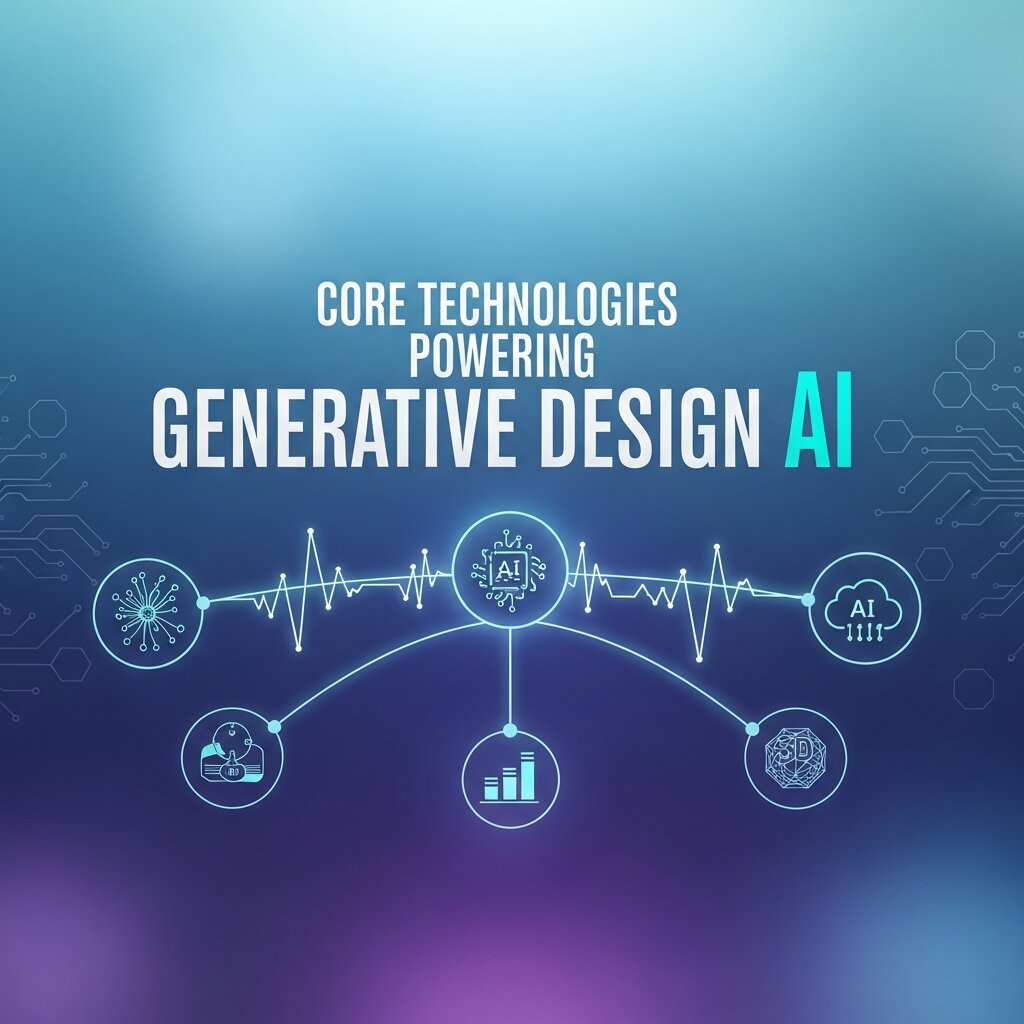
Topology Optimization and Beyond
Topology optimization serves as the backbone of many generative design workflows. This numerical method systematically removes unnecessary material from a design domain, highlighting the critical load paths that ensure structural integrity. By imposing constraints on volume fraction and connectivity, topology routines sculpt organic, lattice-like frameworks that maximize stiffness and minimize mass. In applications like aerospace bracketry or automotive suspension links, this leads to components with superior performance packaged in lighter forms.
Evolutionary Algorithms and Simulation
Evolutionary algorithms mimic the principles of natural selection by generating populations of candidate designs, applying random mutations, and selecting the fittest individuals for subsequent generations. This process, combined with high-fidelity finite element analysis (FEA), allows the system to verify that each shape can withstand real-world loading scenarios. A popular reference for FEA practices can be found on NASA’s official website: https://www.nasa.gov/. By integrating these techniques, generative design AI balances rapid exploration with engineering accuracy.
Machine Learning and Cloud Infrastructure
Machine learning models accelerate generative design by predicting performance outcomes and approximating simulation results. Techniques such as neural networks or surrogate modeling reduce computational load, enabling quick assessments of new design candidates. Additionally, cloud and edge computing platforms provide the parallel processing horsepower required to evaluate thousands of variants concurrently. Institutions like the National Institute of Standards and Technology (NIST) highlight best practices for leveraging distributed computing: https://www.nist.gov/. This seamless scalability ensures organizations can tackle complex projects without investing in costly on-premises hardware.
Strategic Advantages of Generative Design AI
Accelerated Innovation Cycles
One of the most compelling benefits of generative design AI is its ability to compress concept-to-prototype timelines. What previously took design teams weeks or months—exploring multiple geometry options, analyzing each one, and refining the most promising candidates—can now be accomplished in a matter of hours or days. This rapid exploration translates into faster innovation cycles and shorter lead times for critical product launches.
Material Efficiency and Cost Reduction
By focusing material only where it’s structurally necessary, generative design AI minimizes waste and reduces raw material costs. Lightweight parts not only lower manufacturing expenses but also contribute to energy savings during transportation and operation. In sectors like aerospace and automotive, shaving even grams off individual components results in significant fuel economy gains and environmental benefits.
Enhanced Multidisciplinary Performance
Generative design AI can optimize for multiple objectives simultaneously—such as stiffness, thermal conductivity, and vibration damping—ensuring balanced performance across diverse criteria. This multidisciplinary optimization helps engineers deliver well-rounded solutions that satisfy stringent industry standards and regulatory requirements.
Design Freedom and Sustainability
The organic forms generated by AI often unlock aesthetic and functional possibilities that manual methods overlook. Biomimetic structures inspired by natural systems not only look innovative but also improve structural resilience. Furthermore, targeted material distribution aligns with sustainability goals by lowering energy consumption and minimizing manufacturing waste.
Practical Applications Across Industries
Aerospace and Automotive Highlights
In aerospace, generative design AI has produced engine mounts and brackets that reduce weight by up to 40% while preserving safety margins. Automotive engineers leverage these capabilities to develop suspension components and chassis reinforcements with improved crashworthiness and ride comfort. The result is lighter vehicles that meet stringent performance targets and regulatory emissions standards.
Medical Device Innovations
Healthcare companies are adopting generative design AI for patient-specific implants and prosthetics. By generating lattice structures tuned for bone in-growth, these designs promote faster recovery and long-term stability. Hospitals and research centers report enhanced implant integration and personalized fit, improving patient outcomes.
Architecture and Consumer Electronics
Building designers use AI-driven workflows to optimize facade panels for daylight management and thermal performance. Consumer electronics manufacturers apply generative design AI to lightweight housings and internal supports, improving heat dissipation in compact devices. This dual focus on efficiency and aesthetics drives innovation in both construction and gadget ecosystems.
Seamless Integration and Overcoming Challenges

Embedding AI into CAD/PLM Environments
Successfully deploying generative design AI requires integration with existing computer-aided design (CAD) and product lifecycle management (PLM) platforms. Organizations should establish clear objectives—defining primary goals like weight reduction or stiffness targets, alongside secondary aims such as cost or manufacturability. Automated pipelines using APIs and scripting can feed parametric inputs into optimization engines, retrieve results, and store validated models in PLM repositories.
Human-in-the-Loop Feedback
While AI excels at broad exploration, human engineers must guide the process by reviewing AI-generated proposals and injecting domain expertise. Iterative feedback loops enable teams to refine constraints, adjust safety factors, and ensure compliance with quality and regulatory standards. This collaboration fosters trust in algorithmic recommendations and promotes adoption across stakeholders.
Managing Computational and Data Constraints
High-fidelity simulations demand significant processing power and data integrity. Teams should validate material databases and load cases to avoid design inaccuracies. Solutions like cloud bursting and edge-AI acceleration help manage peak workloads without overwhelming on-premises infrastructure. Developing governance practices around data quality and version control is equally important to maintain consistency.
Addressing Manufacturability and Change Management
Some generative designs produce intricate geometries that necessitate additive manufacturing or specialized tooling. Early alignment between design, manufacturing, and supply chain teams ensures that complex shapes can be produced cost-effectively. Equally critical is change management—preparing personnel to work alongside AI systems and trust computational insights. Training programs and pilot projects can build confidence and demonstrate tangible value.
AI-Driven Collaboration in Product Development
 Generative design AI is transforming collaboration between engineering, manufacturing, and product development teams. Traditionally, departments worked in isolated stages, often leading to communication gaps and repeated revisions. Today, AI-powered workflows enable teams to collaborate simultaneously through shared digital environments where design updates, simulations, and manufacturing constraints are synchronized in real time. Engineers can instantly evaluate how design modifications affect structural integrity, while manufacturers can confirm production feasibility during the conceptual stage. This collaborative ecosystem accelerates decision-making and reduces costly redesign cycles. Cloud-based platforms further support remote teamwork by allowing stakeholders across different regions to access the same design models and performance reports. By fostering transparent communication and continuous iteration, generative design AI strengthens cross-functional alignment and helps organizations deliver innovative products faster and more efficiently in competitive global markets.
Additive Manufacturing and 3D Printing Synergy
The rise of additive manufacturing has significantly amplified the value of generative design AI. Many AI-generated structures feature complex organic geometries and lattice frameworks that traditional subtractive manufacturing methods cannot easily produce. However, modern 3D printing technologies make these intricate forms achievable with remarkable precision. This synergy allows engineers to create lightweight yet durable components optimized for strength, airflow, and thermal efficiency. Industries such as aerospace and healthcare particularly benefit because additive manufacturing minimizes material waste while enabling customized production. Designers can rapidly prototype AI-generated concepts, test them in real-world environments, and refine designs without extensive tooling expenses. Furthermore, additive manufacturing supports localized production, reducing transportation emissions and supply chain delays. Together, generative design AI and 3D printing are reshaping manufacturing by enabling faster innovation cycles and unlocking unprecedented levels of design freedom.
Data Security and Intellectual Property Protection
As organizations increasingly adopt generative design AI platforms, protecting sensitive data and intellectual property has become a critical concern. AI systems rely heavily on proprietary engineering files, simulation data, and manufacturing specifications, making cybersecurity essential throughout the design process. Companies must implement strong encryption protocols, role-based access controls, and secure cloud infrastructures to prevent unauthorized access or data breaches. Intellectual property ownership also requires careful consideration because AI-generated outputs may involve collaborative inputs from multiple stakeholders and software providers. Establishing clear legal agreements and governance policies helps organizations maintain control over proprietary innovations and avoid disputes. Regular security audits and compliance monitoring further strengthen protection against evolving cyber threats. In today’s digital environment, balancing innovation with robust data governance ensures that businesses can confidently leverage generative design AI while safeguarding valuable competitive assets.
Sustainability Benefits of Generative Design AI
Sustainability has become a major driving force behind the adoption of generative design AI across industries. By optimizing material distribution and eliminating unnecessary mass, AI-generated components reduce raw material consumption and manufacturing waste. Lightweight products also consume less energy during transportation and operation, contributing to lower carbon emissions throughout the product lifecycle. In architecture and construction, generative systems can optimize airflow, daylight exposure, and thermal efficiency, reducing building energy requirements. Manufacturers are additionally using AI-driven optimization to support circular economy initiatives by designing components that are easier to recycle or reuse. Virtual prototyping further minimizes the need for physical samples, lowering both production costs and environmental impact. As organizations prioritize environmental responsibility in this year (2026), generative design AI provides an effective pathway toward greener engineering practices and long-term sustainability goals.
Real-Time Simulation and Predictive Analytics
Real-time simulation capabilities are elevating generative design AI from a conceptual tool into a predictive engineering powerhouse. Advanced simulation engines can now evaluate stress, vibration, airflow, and thermal performance almost instantly as new design variations are generated. This immediate feedback allows engineers to identify weak points and refine structures much earlier in the development cycle. Predictive analytics powered by machine learning further enhances decision-making by forecasting product lifespan, maintenance requirements, and operational performance under varying conditions. For example, automotive manufacturers can simulate crash scenarios while aerospace engineers can analyze fatigue behavior before physical prototypes are built. These predictive capabilities significantly reduce testing costs and accelerate product validation. By integrating real-time simulations into AI-driven workflows, organizations improve design accuracy, reduce uncertainty, and bring high-performance products to market with greater confidence and efficiency.
Workforce Transformation and Skill Development
 The growing adoption of generative design AI is reshaping the engineering workforce and creating demand for new skill sets. While traditional drafting expertise remains valuable, professionals now need competencies in computational design, data analysis, automation scripting, and AI-assisted optimization. Organizations are investing in upskilling programs to help engineers and designers adapt to collaborative human–AI workflows. Universities and technical institutions are also expanding curricula to include machine learning fundamentals, digital manufacturing, and cloud-based simulation technologies. Rather than replacing human talent, generative design AI shifts professionals toward higher-level problem solving, strategic decision-making, and innovation leadership. Teams spend less time on repetitive modeling tasks and more time evaluating performance trade-offs, sustainability metrics, and user experience considerations. This workforce evolution enables companies to remain competitive while fostering a culture of continuous learning and technological adaptability.
Future Opportunities and Emerging Innovations
The future of generative design AI is filled with opportunities driven by advancements in quantum computing, robotics, and intelligent automation. Quantum-enhanced optimization algorithms may soon solve highly complex engineering problems that are currently computationally expensive, dramatically accelerating design exploration. Integration with robotics could enable fully automated manufacturing systems where AI-generated designs move directly into production with minimal human intervention. Smart materials capable of adapting to environmental conditions may also become integrated into generative workflows, creating products that self-adjust for performance and durability. Additionally, AI-driven personalization will allow manufacturers to produce customized products tailored to individual user preferences and ergonomic requirements at scale. As industries continue investing in advanced digital ecosystems, generative design AI will evolve from a specialized engineering tool into a foundational technology that shapes the future of manufacturing, infrastructure, healthcare, and consumer innovation.
Frequently Asked Questions
What is generative design AI?
Generative design AI uses artificial intelligence and optimization algorithms to automatically create multiple design solutions based on engineering goals, constraints, materials, and performance requirements for faster innovation.
How does generative design AI improve product development?
It accelerates product development by automating design exploration, reducing manual iterations, improving efficiency, lowering costs, and helping engineers evaluate thousands of optimized concepts within shorter timeframes.
What industries benefit most from generative design AI?
Aerospace, automotive, medical device manufacturing, architecture, and consumer electronics have all reported significant advantages when leveraging generative design AI.
How does generative design AI reduce material waste?
By using topology optimization and iterative analysis, the AI places material only where it’s structurally necessary, minimizing excess and lowering raw material costs.
Do engineers need special skills to work with generative design AI?
Engineers should understand CAD/PLM integration and have a basic grasp of optimization principles, but they primarily guide the AI through constraint setting and review final designs.
Human-Centered Innovation with Generative Design AI
Generative design AI represents a paradigm shift in how products are conceived, refined, and manufactured in today’s competitive environment. By combining advanced computational techniques with cloud-enabled scalability, teams unlock unprecedented opportunities to accelerate innovation, reduce material usage, and achieve superior performance. From aerospace brackets and medical implants to architectural facades and consumer gadgets, real-world implementations demonstrate powerful outcomes. Although challenges remain—such as computational demands, data integrity, and manufacturability—organizations that embrace human–AI collaboration and invest in integration frameworks will thrive. As generative design AI continues to mature, it will become an essential tool for engineers, designers, and innovators seeking to push the boundaries of possibility in 2026 and beyond.
Read more about this topic: Choosing Your Path in Information Technology Computer Science



Leave a Reply