

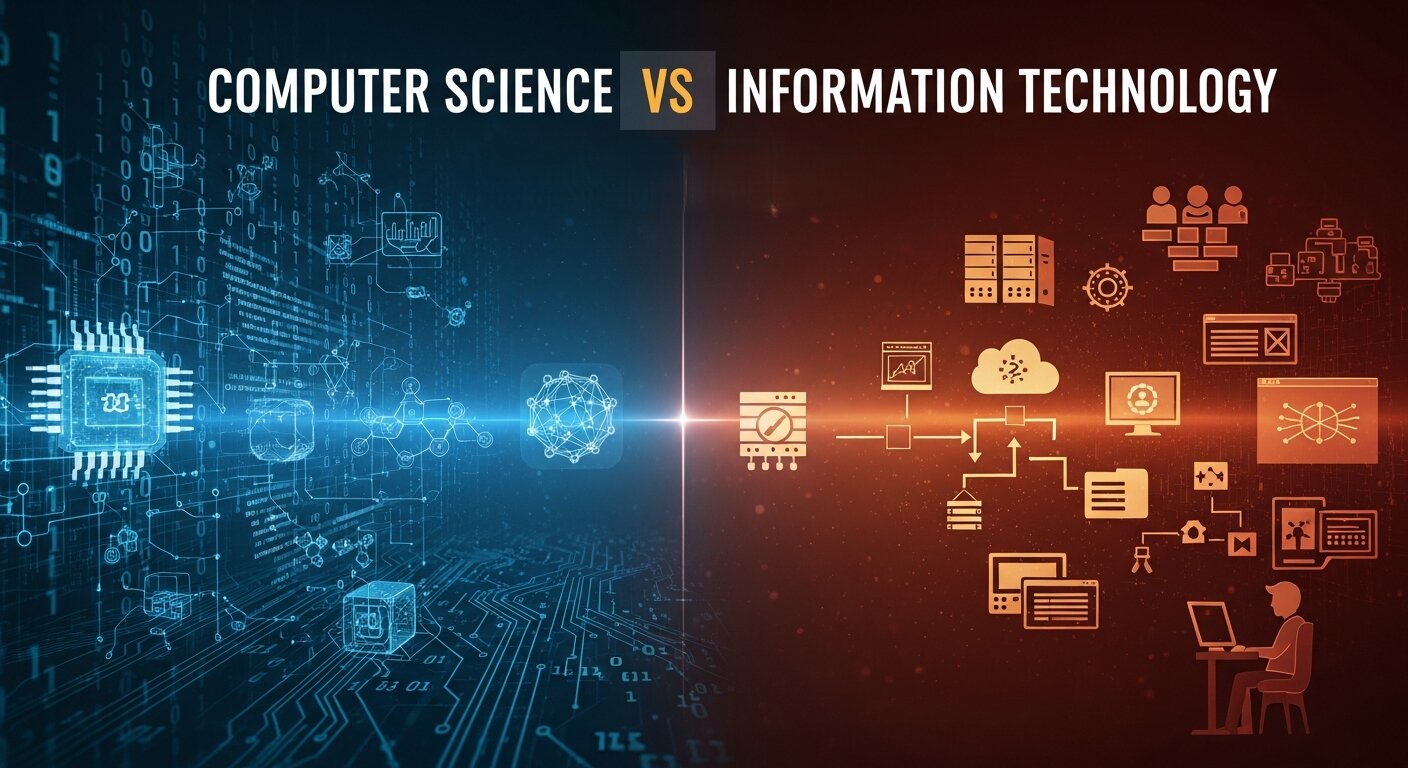
Deciding on a career path in the technology sector can feel like navigating a complex maze. With so many degree programs, boot camps, and specializations available, narrowing down your options requires a clear understanding of what each field actually entails. Two of the most common—and frequently confused—paths are computer science and information technology.
At a glance, both fields involve working with computers, networks, and software. People outside the industry often use the terms interchangeably. However, the day-to-day realities, required skill sets, and long-term career trajectories for these two disciplines are remarkably different. One focuses on creating the fundamental building blocks of software, while the other focuses on applying and managing those systems to solve practical business problems.
Understanding the distinction between computer science vs information technology is essential for anyone looking to invest time and money into their education. Choosing the right path ensures that your daily tasks align with your natural aptitudes and long-term career goals.
This guide will break down the specific skills required for each field, outline the most lucrative job titles, and explore the future scope of both industries. By the end of this post, you will have a clear roadmap to help you choose the tech career that best suits your strengths.
Understanding the Core Differences
To make an informed decision, you first need to grasp the fundamental purpose of each discipline. While they frequently overlap in the modern workplace, their core objectives remain distinct.
What is Computer Science?
 Computer science is the study of computational systems, algorithms, and software design. It is a highly theoretical and math-heavy discipline. Professionals in this field focus on writing code, developing software applications, and designing the architecture that allows computer programs to function efficiently.
If you view a business’s technology infrastructure as a house, computer scientists are the architects and engineers who design the blueprint and build the foundation. They invent new programming languages, develop operating systems, and create complex algorithms that power artificial intelligence. The work requires a deep understanding of discrete mathematics, data structures, and computational theory.
What is Information Technology?
 Information technology (IT) is the practical application of technology to manage business operations. Rather than building software from scratch, IT professionals use existing software, hardware, and networks to ensure a company runs smoothly.
Continuing the house analogy, if computer scientists build the house, IT professionals are the electricians and property managers who ensure the lights stay on and the doors remain secure. A career in computer information technology involves managing databases, configuring computer networks, providing technical support, and securing sensitive data against cyber threats. It requires a strong understanding of how different technological components interact to serve human needs.
Essential Skills for Success
The skills required to succeed in these two fields reflect their different objectives. While basic computer literacy is a prerequisite for both, the advanced competencies diverge significantly.
Computer Science Skill Requirements
Success in computer science demands a highly analytical mind and a tolerance for deep, uninterrupted focus.
Programming Proficiency: You must be fluent in multiple programming languages. Depending on your specialization, this might include Python, Java, C++, or JavaScript. You need to understand how to write clean, efficient, and scalable code.
Advanced Mathematics: Computer science programs require a heavy dose of math. You will encounter calculus, linear algebra, and discrete mathematics. These subjects teach the logical frameworks necessary for writing complex algorithms.
Software Development Principles: You must understand the software development lifecycle. This includes knowledge of version control systems like Git, testing methodologies, and deployment strategies.
Problem-Solving and Logic: A significant portion of a computer scientist’s day is spent debugging code. You need the patience to trace logical errors through thousands of lines of code to find a single missing semicolon.
Information Technology Skill Requirements
Professionals in computer information technology need a blend of technical expertise and strong interpersonal skills. They often serve as the bridge between complex technology and everyday business users.
Network Configuration and Management: IT pros must understand how data travels across local area networks (LANs) and wide area networks (WANs). Knowledge of routers, switches, and firewalls is essential.
Database Administration: Businesses rely on data. IT professionals need to know how to install, configure, and maintain database management systems like SQL Server, Oracle, or MySQL.
Cybersecurity Fundamentals: Protecting company data is a primary responsibility for any IT department. You must understand encryption, threat detection, and how to implement security protocols across an organization.
Communication and Empathy: Unlike computer scientists who might spend days working independently, IT professionals constantly interact with end-users. You must be able to explain technical concepts to non-technical people and remain patient when helping frustrated users resolve software issues.
Popular Career Paths and Job Titles
Both fields offer high earning potential and strong job security. The roles you qualify for will depend heavily on which path you choose.
Top Roles in Computer Science
A degree or background in computer science opens the door to roles focused on creation and innovation.
Software Engineer: This is the most common role for computer science graduates. Software engineers design and build applications for desktop, mobile, and web platforms. They collaborate with product managers to bring new software features to life.
Data Scientist: Data scientists use programming and statistical analysis to extract valuable insights from massive datasets. They build machine learning models that help companies predict consumer behavior, optimize pricing, or automate complex processes.
Systems Architect: These senior-level professionals design the overarching structure of complex software systems. They determine which technologies a company should use to build its applications and ensure that different software components can communicate effectively.
Top Roles in Information Technology
Careers in computer information technology are heavily focused on deployment, maintenance, and security.
Network Administrator: Network administrators are responsible for the day-to-day operation of a company’s computer networks. They monitor network performance, troubleshoot connectivity issues, and upgrade hardware as needed.
Cybersecurity Analyst: As cyber threats become more sophisticated, this role has skyrocketed in demand. Cybersecurity analysts monitor networks for security breaches, investigate violations, and install software to protect sensitive information.
Cloud Infrastructure Engineer: Businesses are rapidly moving their operations to cloud platforms like Amazon Web Services (AWS) and Microsoft Azure. Cloud engineers manage this transition, ensuring that cloud-based applications run securely and efficiently.
Artificial Intelligence and Machine Learning Impact
 Artificial intelligence (AI) and machine learning are transforming both computer science and information technology in powerful ways. In computer science, AI focuses on building intelligent systems, designing algorithms, and training models that can learn from data and make decisions. This includes applications like natural language processing, computer vision, and predictive analytics. In IT, AI is used more practically to automate system monitoring, enhance cybersecurity, and improve customer support through chatbots and virtual assistants. As these technologies evolve, professionals in both fields must understand how AI tools integrate into modern systems. The growing demand for AI-driven solutions is creating new job roles and reshaping traditional career paths across the tech industry.
Certifications and Educational Pathways
Choosing between computer science and information technology also involves selecting the right educational and certification pathway. Computer science students typically pursue degrees that emphasize programming, algorithms, mathematics, and software engineering principles. On the other hand, IT students often focus on network management, system administration, cybersecurity, and practical technology applications. Beyond formal education, certifications play a crucial role in career advancement. For IT professionals, certifications like CompTIA A+, Network+, and Cisco CCNA are highly valuable. Computer science learners benefit from certifications in programming languages, cloud platforms, and data science tools. These credentials help validate skills, improve employability, and provide a competitive edge in the rapidly evolving technology job market.
Work Environment and Daily Responsibilities
The daily work experience in computer science and information technology differs significantly. Computer science professionals often work in development environments where they spend long hours writing code, debugging software, and designing system architectures. Their work is usually project-based and requires deep focus and problem-solving abilities. In contrast, IT professionals typically work in dynamic environments where they manage networks, troubleshoot technical issues, and support end-users in real time. Their tasks can vary daily depending on organizational needs, system updates, or security concerns. While computer scientists may work more independently or in structured development teams, IT professionals interact frequently with employees across different departments, making communication and responsiveness key aspects of their role.
Analyzing the Future Scope
The technology landscape shifts constantly. Understanding the future scope of computer science vs information technology will help you future-proof your career.
The Future of Computer Science
The demand for computer scientists will continue to grow as society becomes increasingly digitized. Artificial intelligence and machine learning are the most significant drivers of this growth. Computer scientists will be needed to develop more advanced neural networks, improve natural language processing, and build ethical frameworks into AI systems.
Quantum computing is another massive frontier. As companies like IBM and Google build more powerful quantum computers, a new generation of computer scientists will be required to write algorithms capable of utilizing this unprecedented processing power. Additionally, the continued expansion of Web3 and blockchain technologies will require developers who understand decentralized systems and smart contracts.
The Future of Information Technology
 The future of computer information technology is heavily tied to cloud computing and automation. As businesses continue to migrate away from on-premise servers, IT professionals will spend less time managing physical hardware and more time configuring virtual environments.
The Internet of Things (IoT) will also drastically impact IT careers. As billions of physical devices—from factory machinery to office thermostats—connect to the internet, IT departments will be responsible for managing and securing these massive, decentralized networks. Furthermore, the shift toward remote and hybrid work environments means IT professionals will be crucial in designing secure, seamless digital workspaces for globally distributed teams.
Frequently Asked Questions
What is the main difference between Computer Science and Information Technology?
The main difference lies in their focus. Computer Science is centered on developing software, algorithms, and systems from scratch, while Information Technology focuses on implementing, managing, and maintaining existing technology solutions to support business operations.
Which field is better for beginners: Computer Science or IT?
It depends on your interests. If you enjoy coding, logic, and mathematics, Computer Science is a better fit. If you prefer practical tasks like troubleshooting systems, managing networks, and working directly with users, Information Technology is more suitable.
Is Computer Science harder than Information Technology?
Generally, Computer Science is considered more challenging due to its strong emphasis on mathematics, algorithms, and programming. IT is more practical and may be easier for those who prefer hands-on work rather than theoretical concepts.
Can I learn Computer Science without a degree?
Yes, many people learn Computer Science skills through online courses, coding bootcamps, and self-study. However, a degree can provide a stronger foundation and better career opportunities, especially for advanced roles.
Do IT professionals need programming skills?
Basic programming or scripting knowledge is beneficial but not always mandatory. Many IT roles focus more on system management, networking, and security rather than full-scale software development.
Which career has more job opportunities?
Both fields offer strong job prospects. Computer Science roles are in high demand in software development, AI, and data science, while IT roles are essential in network management, cybersecurity, and cloud computing. Demand depends on industry trends and specialization.
Which field is better for future growth?
Both have excellent future potential. Computer Science is leading in areas like artificial intelligence, machine learning, and software innovation. IT is growing rapidly in cloud computing, cybersecurity, and infrastructure management.
Can I switch from Computer Science to IT later?
Yes, switching is possible. Many skills overlap, and with some additional learning—such as networking or system administration—you can transition between the two fields.
Charting Your Path in the Tech Industry
Choosing between computer science and information technology ultimately comes down to your personality, interests, and preferred working style. If you love solving complex logical puzzles, creating things from scratch, and diving deep into mathematics, computer science is likely your ideal fit. On the other hand, if you prefer hands-on troubleshooting, managing systems, and interacting directly with the people who use technology, a career in computer information technology will serve you well.
Take the time to assess your natural strengths. Try your hand at a basic coding tutorial to see if you enjoy the syntax and logic of programming. Alternatively, look into basic network configuration or hardware troubleshooting to see if you prefer the applied side of technology.
If you are ready to take the next step, consider looking into foundational certifications. For aspiring IT professionals, the CompTIA A+ certification offers a great introduction to hardware and networking. For those leaning toward computer science, completing an introductory Python or JavaScript course on a platform like Coursera or edX can provide a solid baseline for your future studies.



Leave a Reply