


Building software that actually works—reliably, efficiently, and at scale—is harder than it looks. Behind every seamless app or platform is a team that made thousands of small decisions: how to structure code, how to test it, how to collaborate, and how to maintain it over time. Get those decisions right, and you build something great. Get them wrong, and you spend months fixing problems that should never have existed.
This post breaks down the most important software development best practices for teams that want to build high-quality applications. Whether you’re managing a large engineering department or leading a small product team, these principles apply across the board. By the end, you’ll have a clear framework for writing better code, shipping faster, and reducing technical debt before it becomes a crisis.
Why Software Development Best Practices Matter More Than Ever
The demand for reliable technology solutions has never been higher. Businesses across every industry depend on software to manage operations, engage customers, and drive revenue. At the same time, the complexity of modern applications has grown dramatically—distributed systems, microservices, cloud infrastructure, and intricate computer networking all create new failure points.
Poor development practices amplify these risks. Bugs slip into production. Systems fail under load. Security vulnerabilities go unpatched. Teams spend more time maintaining existing code than building new features. The cost of bad software is enormous—not just financially, but in customer trust and team morale.
Best practices exist to address these problems systematically. They’re not just theoretical ideals; they’re lessons distilled from decades of real-world software development, tested against actual failures and refined over time.
How to Write Clean, Maintainable Code
 Good software starts with good code. Clean code is easy to read, easy to test, and easy to modify. These qualities might sound obvious, but they’re surprisingly difficult to maintain consistently—especially as codebases grow and teams change.
Follow established coding standards and style guides
Every team should agree on a consistent set of coding standards before writing a single line of code. This includes naming conventions, file structure, comment formatting, and how to handle errors. Tools like ESLint for JavaScript, Pylint for Python, or Checkstyle for Java can automate enforcement, removing the burden from code reviews.
Consistent style means any developer on the team can pick up any file and understand it quickly. That’s invaluable when debugging at 2 a.m. or onboarding a new hire.
Apply the SOLID principles
The SOLID principles are five foundational guidelines for object-oriented software development:
- Single Responsibility: Each class or module should do one thing well.
- Open/Closed: Code should be open for extension but closed for modification.
- Liskov Substitution: Subtypes should be interchangeable with their base types.
- Interface Segregation: Don’t force modules to implement interfaces they don’t use.
- Dependency Inversion: Depend on abstractions, not concrete implementations.
Applied consistently, these principles reduce coupling, improve testability, and make systems far easier to extend over time.
Keep functions small and focused
Long, multi-purpose functions are one of the most common sources of bugs in software development. Aim to write functions that do exactly one thing and do it well. If a function is approaching 30–40 lines, that’s a signal it may need to be broken apart. Small functions are easier to name, easier to test, and easier to reuse.
Version Control: The Backbone of Collaborative Development
 No software team should be working without version control. Git has become the industry standard, but the tool itself is only part of the equation. How you use it matters just as much.
Use a branching strategy that fits your team
Popular branching strategies like GitFlow or trunk-based development each have their place. GitFlow suits teams with defined release cycles, while trunk-based development works well for teams practicing continuous deployment. The key is to pick one approach and stick to it.
Feature branches should be short-lived. The longer a branch sits without being merged, the more divergent it becomes from the main codebase—and the more painful the merge will be. Aim to integrate changes frequently, at least once a day.
Write meaningful commit messages
A commit message is documentation. Future developers—including your future self—will rely on commit history to understand why a change was made. Follow a clear format: a concise subject line, followed by a more detailed body when needed. Referencing issue or ticket numbers helps connect changes to the problems they solve.
Testing: Building Confidence in Your Code
Testing is one of the highest-leverage activities in software development. A well-tested codebase allows developers to move fast without fear of breaking things. An untested codebase creates the opposite dynamic—every change becomes a gamble.
Adopt a layered testing strategy
Effective testing combines multiple levels:
- Unit tests verify individual functions or components in isolation. They run fast and catch regressions early.
- Integration tests check how different parts of the system interact—particularly important in systems with complex computer networking or database dependencies.
- End-to-end tests simulate real user behavior through the full application stack, from the interface down to the database.
Aim for a test pyramid: a large base of unit tests, a smaller layer of integration tests, and a select set of end-to-end tests. This structure keeps your test suite fast and reliable.
Practice Test-Driven Development (TDD) where it adds value
Test-Driven Development—writing tests before writing the code they test—sounds counterintuitive, but it produces measurable benefits. TDD forces developers to think clearly about requirements before implementation. It results in more modular, testable code and reduces the time spent debugging later.
TDD isn’t always practical for every feature, but applying it to core business logic and complex algorithms consistently pays off.
Code Reviews: Making Quality a Team Responsibility
Code reviews are one of the most effective quality control mechanisms in software development. They catch bugs, enforce standards, spread knowledge across the team, and create a shared sense of ownership over the codebase.
Keep pull requests small and focused
Large pull requests are hard to review thoroughly. A 1,000-line diff is likely to get a cursory glance and an approval. A 100-line diff gets scrutiny. Small, focused pull requests are reviewed faster, merged sooner, and introduce fewer defects. Aim to keep pull requests scoped to a single feature or fix.
Give constructive, specific feedback
Code review comments should explain the why behind feedback, not just flag problems. “This function is too long” is less useful than “This function handles both data fetching and data transformation—splitting it into two would make each easier to test.” Good feedback teaches; it doesn’t just criticize.
Documentation: Writing Code That Explains Itself
Documentation is often treated as an afterthought, but it’s an integral part of a high-quality software development process. Well-documented code reduces onboarding time, prevents knowledge silos, and saves hours of reverse-engineering.
Write self-documenting code first
The best documentation is clear code. Use descriptive variable and function names that communicate intent without requiring a comment. calculateMonthlyRevenue() needs no explanation; calc() requires context every time it’s encountered.
Reserve comments for the non-obvious—explaining why a workaround was necessary, or documenting a known limitation of a third-party library.
Maintain a living README and architecture overview
Every project should have a README that explains how to set up the development environment, run tests, and deploy the application. For larger systems, an architecture overview documenting key components, data flows, and computer networking topology helps new team members understand the system quickly—and gives experienced developers a shared mental model to reason from.
Security: Building It In, Not Bolting It On
Security is not a feature you add at the end of a project. It needs to be embedded throughout the software development lifecycle.
Adopt a shift-left approach to security
Shift-left means moving security testing earlier in the development process, rather than waiting for a final audit before release. This includes using static analysis tools to catch common vulnerabilities, requiring security-focused code reviews for sensitive areas, and training developers to recognize insecure patterns.
Common vulnerabilities—SQL injection, cross-site scripting, insecure deserialization—are well-documented and largely preventable with the right habits and tooling.
Treat secrets and credentials carefully
Hardcoding API keys, database credentials, or tokens in source code is a critical mistake that continues to affect even experienced teams. Use environment variables or dedicated secrets management tools. Audit your repositories regularly to ensure no sensitive data has been committed.
Performance and Scalability: Designing for Growth
High-quality applications don’t just work—they work well under pressure. Performance and scalability should inform architectural decisions from the start, not become retrofit problems after launch.
Profile before optimizing
Premature optimization is a well-known trap. Before spending time optimizing code, profile the application to identify actual bottlenecks. Tools like New Relic, Datadog, or built-in profilers for most languages can pinpoint exactly where time and resources are being consumed.
Optimization effort should follow evidence, not assumption.
Design with scalability in mind
Consider how your technology solutions will behave as usage grows. Will the database handle ten times the current load? Will the computer networking infrastructure support higher throughput? Building with horizontal scalability in mind—using stateless services, caching layers, and load balancers—makes future growth far less disruptive.
Continuous Integration and Deployment: Automating Quality
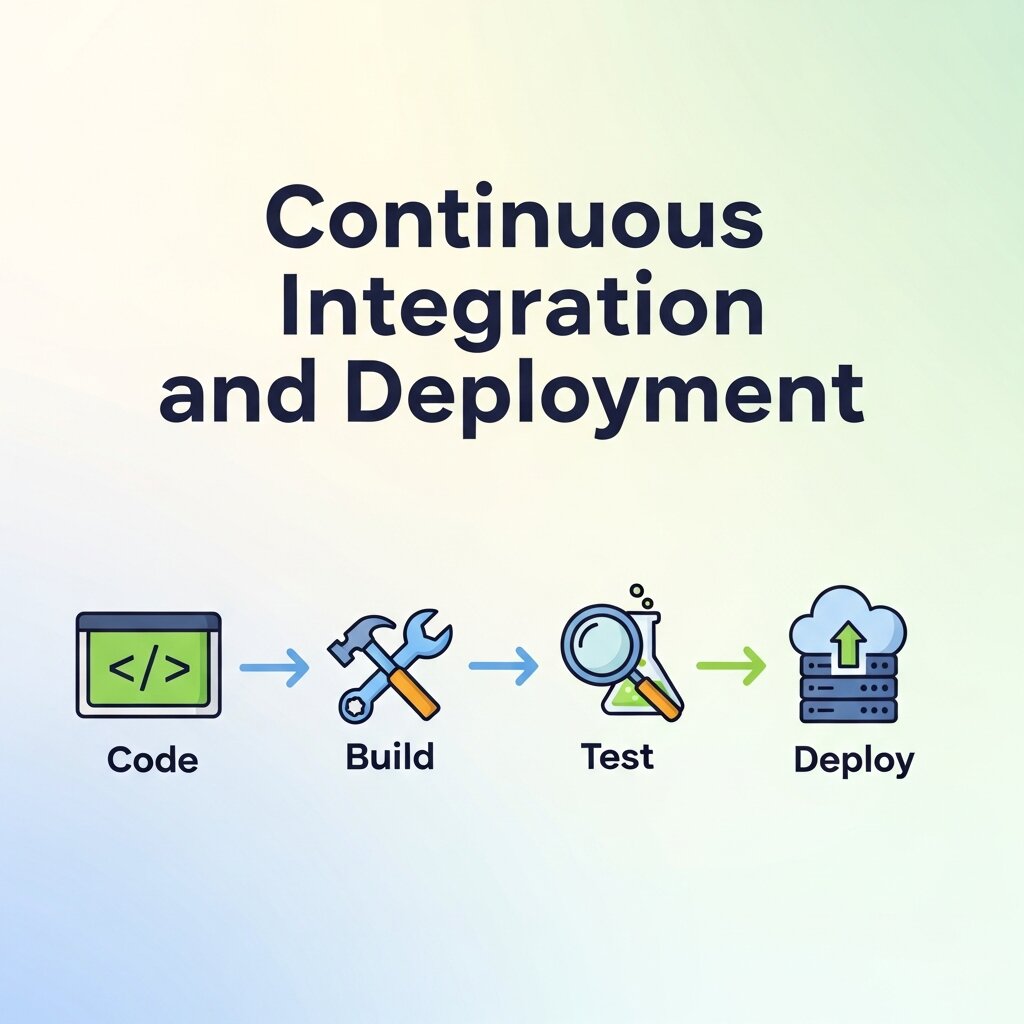 Continuous Integration (CI) and Continuous Deployment (CD) pipelines automate the process of testing and deploying code, reducing human error and enabling faster, safer releases. A mature CI/CD pipeline typically includes automated testing, static analysis, build verification, and staged deployments with rollback capability.
Every code change runs through this pipeline before reaching production—creating a consistent, repeatable path from development to release. Teams that invest in CI/CD infrastructure ship features faster and experience fewer production incidents. The upfront effort to build and maintain pipelines pays dividends for the life of the project.
Building Software That Lasts
Great software doesn’t happen by accident. It results from deliberate choices made consistently across every stage of development—from the first line of code to the final deployment.
The practices outlined here aren’t revolutionary. They’ve been refined by the software development community over decades of building and maintaining real systems. What makes the difference is commitment: applying these principles consistently, revisiting them as your team grows, and treating quality as a continuous pursuit rather than a one-time goal.



Leave a Reply